







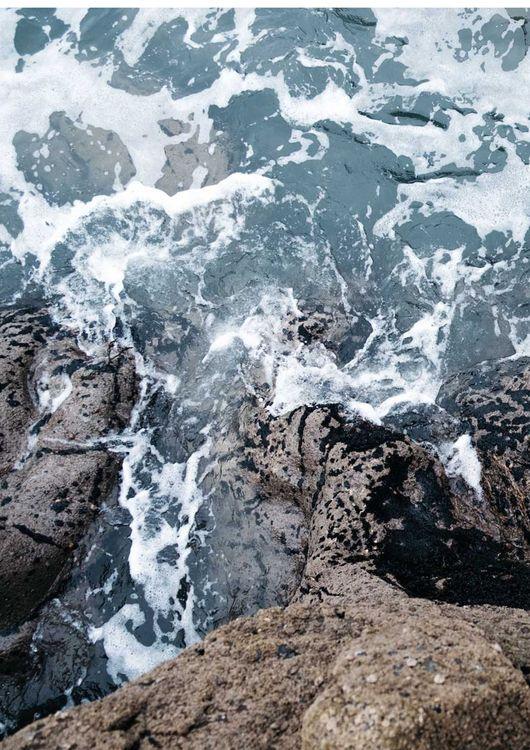
Just add water: the secret wellbeing ingredient
There are some things that require little explanation, no matter how easy the science would be to prove them. Getting stuff for free always feels good, don’t shop on an empty stomach – all those things your mum said that you wish you’d listened to.
One of the easiest ones to understand is that spending time near water is a near-magical experience. How fun it is to surf, how refreshing a cold-water swim is, or how moving a wander down a coastal path in the salty air is – hours after doing them, late that evening, maybe even the next day – you still feel great. It really is that simple, but for the sake of knowing – why is time spent near water so good?
Blue spaces
If you’ve ever opened an email from us, heard the podcast, or taken a quick browse through the blog – you might’ve heard us mention the phrase ‘green space’ once or twice. As it turns out, there’s a mirror term for places near water – ‘blue spaces’.
The benefits of being near a blue space, whether scientifically provable or not, have been known for centuries, possibly millennia, with ample examples of superstitions and traditions around water sources. Whether you’re talking about the ‘healing’ Chalice Well in Glastonbury, supposedly a place of pilgrimage for thousands of years, the thermal spas of Bath associated by the Romans with Sulis Minerva, or even the Onsens of Japan or the Ganges River in India – there are traditions worldwide.
More recently, even Victorian doctors suggested a seaside spell for healing purposes, falsely believing that ‘ozonised air’ would be beneficial, not realising it was likely mostly the lack of smog on the coast that was doing people the largest part of the benefit.
‘Blue spaces’ as a term, however, is much newer, and much better explained.
A return to the old ways
The slow turn of time, generally speaking, leads to progress. And that progress tends to lead to compounding benefits. Once we discover this, we discover that. We’ve barely made it to 100 years after antibiotics, and we’re performing surgeries once thought impossible to achieve, and developing transplants using tissue grown in a lab.
This is not to say however, we’ve got it all right. Reporting on the idea of blue spaces in a BBC article, Frankie Adkins and Katherine Latham explain:
“The loss of human-nature interaction has been linked to a rising tide of mental health disorders. A growing body of evidence indicates that human health, both mental and physical, is intrinsically linked to nature.
Just looking at natural scenery has been found to cause rapid beneficial psychological and physiological changes in salivary cortisol, blood flow, blood pressure and brain activity. Meanwhile, contact with microbes in the environment can ‘train’ our immune systems, reinforcing the good microbial communities on our skin and in our airways and guts.”
So in some senses, reverting a little might be a good idea and the draw to blue spaces humans feel might just be evolutionarily favourable behaviour – following water to abundant sources of life. In fact, humans are able to smell geosmin (the petrichor smell after rain), at a sensitivity of 0.4 parts per billion to 5 parts per trillion – making humans more sensitive to the smell of damp or water, than sharks are to blood. It’s theorised that it may be to help us seek out water.
Where we’re happiest
As it turns out, we might be right to be drawn to water. Aside from the obvious life-saving benefits of a fresh clean glass of the see-through stuff, there are some pretty clear benefits to a little time beside the big blue. Or even, just a little blue.
According to a 2021 government report that included some robust studies, “those who moved to the coast reported improved physical and mental health, and vice versa. The pattern of better mental health, in particular, in coastal living communities has been repeatedly confirmed in subsequent studies.”
It goes on to list why, citing that coastal environments typically had reduced exposure to air pollution, it’s easier to facilitate physical and social activities and best of all – it was simply easier to relax on the coast. And better yet, there’s a suggestion that it’s equally effective if you’re close to water inland too.
But aside from the improved health outcomes, there’s a pretty clear benefit – people who live near water are simply happier. Back in 2013, a study of 20,000 people was conducted, in which participants were asked to rate their happiness whilst using GPS to track their location. Naturally (yes that’s a pun), they were happiest in nature. Green spaces far more than urban ones, but overall, most happy in ‘marine and coastal margins’.
But why?
The why of it is hard to narrow down to one ‘grand theory of happiness and health’ – but if you had to, it’d go something like this: Why’s a bee happiest in a flower? Or a clownfish in the reef? We’ve always naturally gravitated towards areas that offer us ‘the greatest reproductive success’ – leading us to areas like savannah and forest, and as such, over tens of thousands of years, our brains and bodies have adapted alongside our environments to be suited to these places.
Most of our senses seem to be attuned to natural stimuli. Things of human design have mostly straight lines, and the odd curve, but things in nature can’t be described with straight lines like a flatpack table. You have to describe them in fractals, repeating patterns that recur at progressively smaller scales (obvious examples include pinecones, Romanesco broccoli or seashells).
Interestingly, it takes 100-400 microseconds to blink, yet we can detect fractals with our eyes in 50 milliseconds. And, physicist Richard Taylor has found that “fractals can reduce stress and mental fatigue for the observer by as much as 60 percent”, going on to say some research showed “hospitalized patients could heal faster when they had access to a window because looking outside, at all of the natural fractals, helped patients relax their bodies and heal faster”. You can take a guess at what kind of patterns we see when we’re watching the waves at the beach.
Not to mention of course, the fact that just listening to “rippling water” had the greatest effect on reducing stress markers, over music or silence. And there’s plenty more studies where that came from, with another suggesting that listening to natural sounds like birdsong or flowing water helps people relax and focus better than artificial noises, promoting brain activity linked to being calm and reduced stress in the body.
Where to go from here…
There’s plenty of evidence that spending time in or around blue spaces is great for you, and there’s other studies about whether cold plunges or sea swimming or wild swimming in rivers is good too. Whether it’s the icy depths of the ocean, or the vaporised form that lingers in a sauna, water seems to be one of our greatest health allies. So if you’re stuck for plans this weekend, just know, a trip to the beach might be just what the doctor ordered.
Other articles you might like
What do outdoorsy people do in winter? Meet Sian Sykes