



How are people searching, booking and travelling?
1. Is 'glamping' dead?
2. Where does social media fit into the booking journey now?
3. How is this affecting marketing activity?
4. What's the one big takeaway?
The travel industry is resilient. Even when times are hard, people ring-fence money for holidays, but while the market is currently bearing up under the cost-of-living strain, there's no room for complacency and success is about more than adding capacity.
A cost-conscious and discerning audience are looking to squeeze everything they can from their spend, so differentiation is the key - not to just getting bookings but to getting seen at all, as a new era of online behaviour begins to take shape.
Let's dive into the detail and follow the journey all the way through.
Is 'glamping' dead?
The way people search for holidays is becoming much more specific. Rather than starting with broad searches such as “glamping UK”, people have a much clearer idea of what they want, like a treehouse in the woods or a remote cabin for two.
The single term "glamping" still generates plenty of traffic, but its relevance is being eroded by the more conversational input of AI search tools, which allow users to focus in on more personalised, emotion-led experiences.
This means that optimising for glamping or other keywords naturally gives way to more narrative, detail-oriented content, which AI tools will serve to prospective guests. Because AI results often remove the need for clicking through to a website, being mentioned and cited as a trusted source takes on huge importance.
AI is going to become an even more established part of the discovery journey in 2027, but the more synthetic the internet becomes, the more valuable genuinely human stories will be.
For Canopy & Stars, that will mean leaning into the things that can’t be generated from a generic accommodation description, like the character of a place, the story behind it and the experience of staying there; all captured by our inspection process. In a world where AI can answer almost anything, those details may be what make people want to go.

Where does social media fit into the booking journey now?
Social media is still a bookings powerhouse which rewards those who do it well. Of our new bookers over the last 2 years, 28% came from social media. For many customers, it's the place where a brand exists most vividly in their minds. But as more brands compete for attention, breaking through the noise - and even appearing in your followers’ feeds - has become harder.
Video content is king, making it even more difficult for time-poor small businesses and individual owners to produce high-quality, engaging content. Gone are the days when a simple photo carousel would get you a thousand likes.
The smart move here is actually to go in the opposite direction. Over the past 18 months, we’ve seen growing engagement with content that feels personal, less polished and built around a strong story. The rise of AI has only accelerated this appetite for content that feels recognisably human: real people, real places and stories that offer something beyond a straightforward sales message.
This is where we see a real opportunity for our owners. The things that make a place distinctive; the people behind it, the details, the unexpected moments and the story of how it came to be, are exactly the things to bring to life through social. In an increasingly digital world, the most compelling thing we can put on someone’s screen might be a reason to turn it off.
How is this affecting market activity?
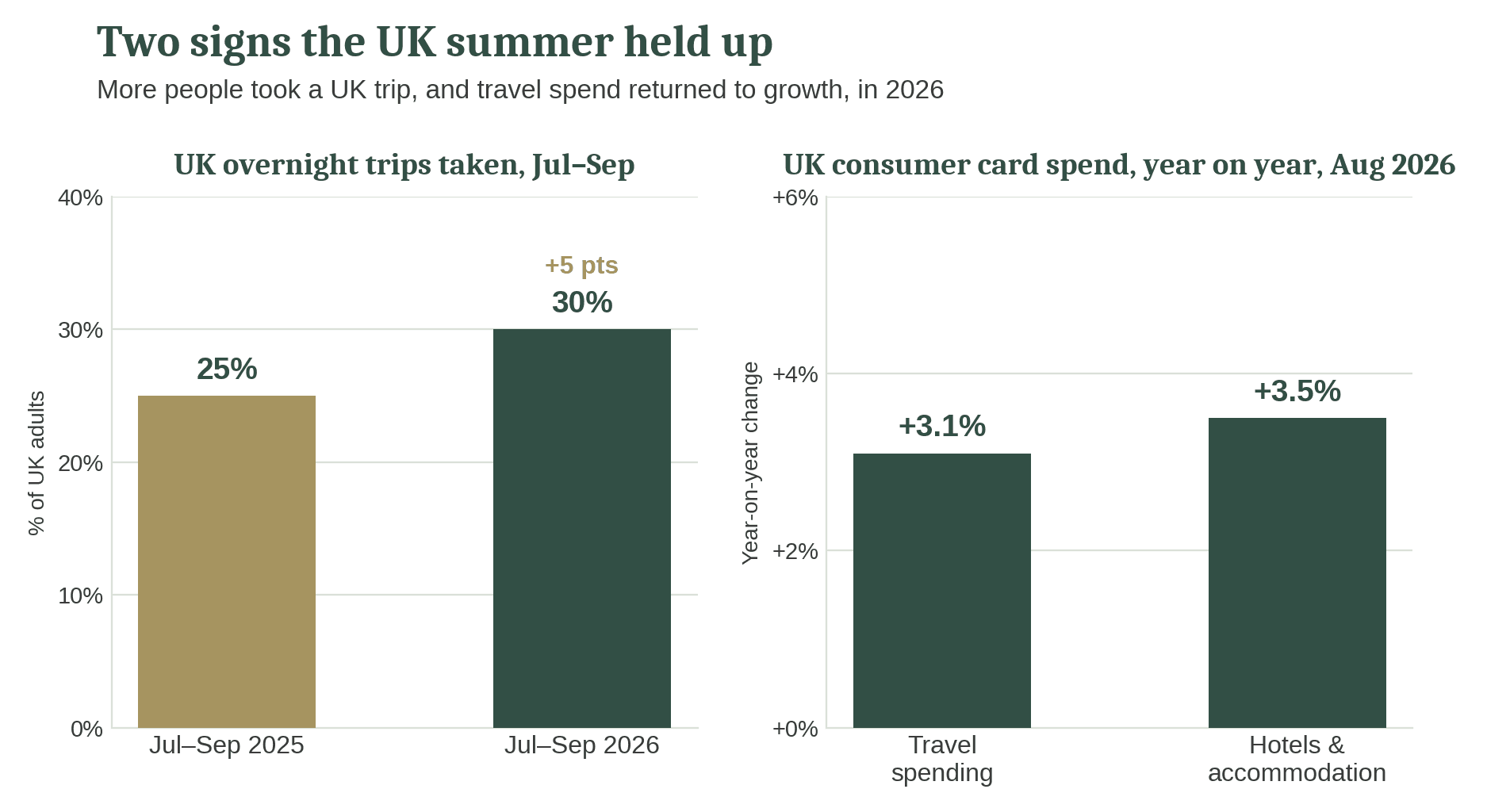
So, the way we search and what we respond to is being altered by AI, but the good news is that when we do look up from the screen, we're still committed to travelling. UK consumer confidence fell to -14.1% in the first quarter of 2026 but that dependable ring-fencing of the travel budget was evident in an August surge, when spending on holidays grew 3.1% against the same period in 2025.
Sources: Deloitte Consumer Tracker, Q1 2026 | Barclays Consumer Spending Report, August 2026
A strong domestic market...
Where UK travel is strongest at the moment is on the domestic front. In a Visit Britain survey from September 2026, 78% of respondents said they were planning an overnight trip in the UK in the following six months, which was a three-point rise from the same survey the previous year.
Sources: - VisitBritain Domestic Sentiment Tracker, September 2026
...With a note of caution
Consumers are becoming more selective about where they spend. Cost-of-living has gone up 29% by some measures, with holiday/leisure costs only just behind at an eye-watering climb of 28%. In another survey from early 2026, this time by Deloitte, 45% of respondents said they were being more frugal with their spending, so the travel budget, while protected, was still shrinking, even if that focus was mostly on removing costs like flights by staying in the UK.
Sources: Deloitte Consumer Tracker, Q1 2026 | VisitBritain Domestic Sentiment Tracker, September 2026
Standing out is the key
Well, standing out plus being comfortable at all times, but that was a less snappy title. If people are spending less on travel and being more selective about what they spend it on, then you'll need to work harder to get bookings. Your place needs to be distinctive, interesting and clearly demonstrate its value.
To really make it work for you, it also needs to be open year-round. Of course, more availability means more potential revenue, but with 35% of people citing the UK weather as a barrier to holidaying at home, it's not just about opening up the calendar.
It's important to show your place would be fun to stay in, not just bearable, in all conditions. Our guest data shows an unusual willingness to travel off-peak, with 83% saying they’d holiday in October, 50% in November and 54% in February. The autumn and winter market is a real chance to smooth out those seasonal dips in income.
Sources: VisitBritain Domestic Sentiment Tracker, September 2026 | Canopy & Stars Guest Survey 2026
Being flexible helps too
Now that you've stood out enough to get the robots to tell the real people about you, you need to look at how those people want to book and how long for.
Our median lead times has come down from 52 days to 49 days, showing how people are playing things safe and booking later than they used to.
They're also trimming stay lengths, with more than half of respondents in a Hilton report favouring "micro-trips" over big holidays. With this figure rising to 74% when you isolate Gen Z, it's clear that shorter stays are more attractive generally and may well remain so for some time, meaning flexibility around your booking pattern or low midweek pricing offers are good to implement where you can.
Sources: Canopy & Stars Booking Data & Hilton's 2027 Trends Report
What's the one big takeaway?
Basically, despite a changing internet landscape allowing guests to search more quickly and in more detail, character and quality are still the most important factors, while a bit of flexibility can help you convert people who love your place online, into booking guests.
Why we're one of the highest scoring travel B Corps in the world
People
We're majority employee owned, which means we all get a say in how the business is run.

Profit
Our Charitable Trust uses 24% ownership of the company to support environmental causes

Planet
We're committing to raise £50,000 by 2027 to help protect nature in our national parks.